
The fight against global warming has taken another significant turn, as scientists have discovered a game-changing technology that could potentially slow down the rate of climate change. In a breakthrough that’s sending shockwaves through the environmental community, researchers have found that “enhanced rock weathering” – a process that involves crushing silicate rocks and adding them to crop soil – can bind carbon dioxide into stable mineral forms that last for millennia.
In this in-depth article, we’ll delve into the world of carbon sequestration, explore the science behind enhanced rock weathering, and examine what this means for our future. We’ll also discuss the implications of this technology, its potential applications, and what’s next in the quest to combat climate change.
The Problem: Global Warming
Global warming has been a pressing issue for decades, with far-reaching consequences for our planet and its inhabitants. The science is clear: human activities, particularly the burning of fossil fuels, have released massive amounts of greenhouse gases into the atmosphere, leading to rising temperatures, more extreme weather events, and devastating impacts on ecosystems.
The good news is that there are ways to slow down global warming, and one of the most promising approaches involves capturing carbon dioxide from the atmosphere. However, this is a complex task, requiring significant technological innovation and investment.
The Technology: Enhanced Rock Weathering
So, what exactly is enhanced rock weathering? The process involves crushing silicate rocks into a fine powder, known as “rock dust.” This rock dust is then added to crop soil, where it naturally reacts with carbon dioxide in the atmosphere. The reactions bind the carbon into stable mineral forms that can persist for millennia.
This technology has been hailed as a game-changer by environmental scientists, who argue that it offers a scalable and sustainable solution to capturing carbon dioxide from the atmosphere. By leveraging the natural processes of rock weathering, researchers believe they can create a new generation of carbon sequestration technologies that are both effective and cost-efficient.
How Does it Work?
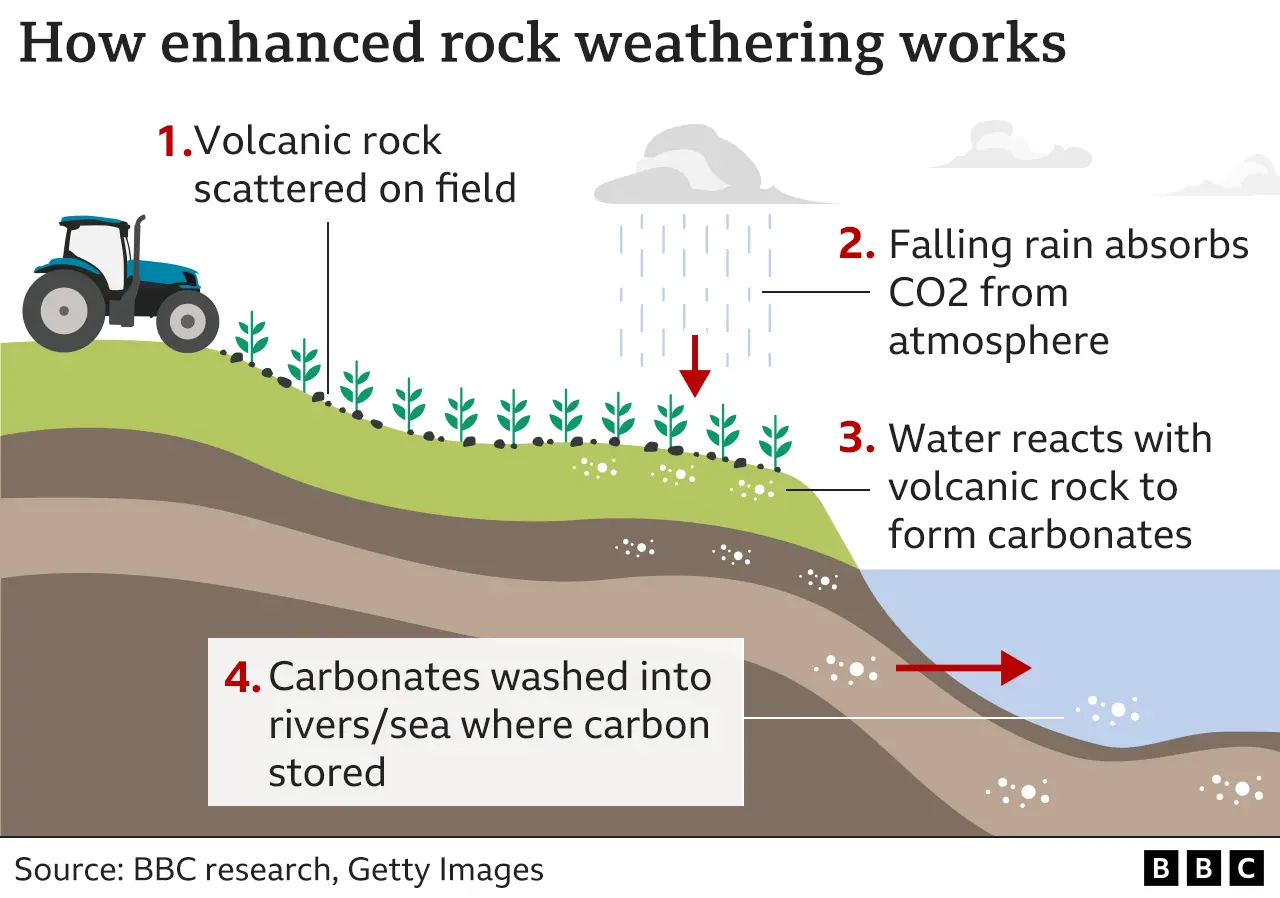
The process is relatively simple. Silicate rocks, such as granite or basalt, are crushed into tiny particles using specialized machinery. These particles, known as rock dust, are then added to crop soil, where they react with carbon dioxide in the atmosphere. The resulting minerals, such as calcite or dolomite, are stable and can persist for thousands of years.
The reactions that occur between the rock dust and carbon dioxide are complex and multifaceted. However, scientists have identified several key mechanisms that contribute to the binding of carbon:
Why is Enhanced Rock Weathering a Game-Changer?
Enhanced rock weathering has the potential to revolutionize our approach to carbon sequestration. For several reasons:
What’s Next?
As we move forward with enhanced rock weathering, several questions arise. How will this technology be deployed? What regulatory frameworks will govern its use? And what are the potential applications for this technology?
These are just a few of the many questions that need to be addressed as we explore the potential of enhanced rock weathering.
Potential Applications
Enhanced rock weathering has far-reaching implications for a range of industries, including:
Challenges and Opportunities
While enhanced rock weathering offers significant potential, it also presents several challenges. For example:
Despite these challenges, researchers remain optimistic about the potential of enhanced rock weathering. By working together to address the obstacles and opportunities presented by this technology, we can create a more sustainable future for generations to come.
The Future of Carbon Sequestration
As we move forward with enhanced rock weathering, it’s clear that our approach to carbon sequestration will need to evolve. New technologies and innovations are emerging all the time, each offering unique solutions to the challenge of capturing carbon dioxide from the atmosphere.
Enhanced rock weathering is just one piece of this puzzle, but it has the potential to make a significant contribution to our efforts to combat climate change.
Conclusion
The discovery of enhanced rock weathering offers a promising solution to the problem of global warming. By leveraging natural processes, researchers believe that this technology can bind carbon dioxide into stable mineral forms that persist for millennia. While challenges remain, the potential applications and benefits of enhanced rock weathering are significant.
As we move forward with this technology, it’s clear that our approach to carbon sequestration will need to evolve. New technologies and innovations are emerging all the time, each offering unique solutions to the challenge of capturing carbon dioxide from the atmosphere.
By working together to address the obstacles and opportunities presented by enhanced rock weathering, we can create a more sustainable future for generations to come.
For more information on this groundbreaking technology, visit [the original source](https://www.msn.com/en-us/news/other/widespread-enhanced-rock-weathering-could-slow-global-warming/ar-AA1Wt1hr).